Why You’re Here: Ethics for the Real World is John Stackhouse’s contribution to a conversation about ethics. For Stackhouse, ethics are not a simple list of good things and bad things but are instead the character or essence of the thing. Stackhouse uses this definition to suggest a reason why we are here: to maximize shalom. Maximizing shalom means we have a job to do. The book begins with a statement of what God expects of all people, then does the same regarding God’s expectation of Christians in particular, and then closes with some thoughts about what this looks like in practicality, which is where I found the majority of benefit in reading.
Showing posts with label Book Reviews. Show all posts
February 21, 2018
August 18, 2013
Book Review - C. S. Lewis' Mere Christianity
C. S. Lewis’ Mere Christianity is a consideration of Christian belief. Borrowing from Acts 11:26, Lewis broadly
defines a Christian as a person who follows the teaching of the apostles. Lewis wants to explain the essence of such
following. Hence, Mere Christianity. Lewis’ explanation of mere Christianity
requires four steps (each each presented in an individual book that comprise
the entirety of Mere Christianity). It begins with an attempt to establish facts
that allow Christianity to make sense. Lewis then places Christian doctrine into
dialogue with these facts to see if it addresses the needs such facts create, followed
by an exploration of how such doctrine affects morality. Lewis concludes with a discussion of who the
Christian God is and what this God is turning people into.June 29, 2013
Book Review - N. T. Wright's Scripture and the Authority of God
In Scripture
and the Authority of God, N. T. Wright attempts to make sense of the claim
that The Bible (scripture) is authoritative. Wright’s argument is that the authority of scripture is more complex than saying that scripture
provides correct information. Instead,
it means that the Christian God exercises his authority through scripture and has
a plan to redeem all of creation. Scripture
spurs the completion of this plan through people. The best way to understand this is to read
the Bible as a five-act story. The first
four acts – creation, the fall, Israel, and Jesus – are already complete. The fifth act – the church – began at Easter/Pentecost. Scripture includes accounts and writings from
early in this act and Christians today continue to live in this act.
March 5, 2013
Book Review - Chris Hedge's Empire of Illusion
Chris Hedges offers a sombre reflection
on America in the early 21st Century, which is easily applicable to
my own Canadian context. Empire of Illusion: The End of Literacy and
the Triumph of Spectacle argues that we made five trades. We traded rational and literate discourse for
celebrity worship and intentional ignorance.
We traded love and empathy for pornography and consumerism. We traded curiosity for entrenchment. We traded happiness and for positive thinking
and ignoring reality. We have traded
democracy, truth, and confidence for misguided icons, negligence, and shopping. Worse than making these trades, however, is
that we think that we are advanced for having done so.January 17, 2013
Book Review - N. T. Wright's Simply Jesus
December 3, 2012
Book Review - Shane Claiborne and Tony Campolo's Red Letter Revolution
Red Letter Christians are Christians who
embrace evangelical theology, while striving to reflect what Jesus said
(hence, “red letter”). Tony Campolo and
Shane Claiborne had frequent discussions about what being a Red Letter
Christian entails. The book Red Letter Revolution: What If Jesus Really
Meant What He Said? highlights these discussions. Asking what it looks like when Christians
start to be intentional about following Jesus will undoubtedly cause conflict. The authors hope that Red Letter Christians
will be a “positive irritant” that will grow in number and naturally become
advocates for social justice and illustrators of spiritual disciplines. September 30, 2012
Book Review - Timothy Keller's Generous Justice
A
basic biblical lesson is that Jesus came to earth to offer forgiveness. Timothy Keller wrote Generous Justice to give light to another basic biblical lesson that
people commonly ignore and overlook: When a person has a true encounter with forgiveness,
she or he will “inevitably” long for justice.
The better a person understands grace, the more acute this longing will
be. Generous
Justice hopes to make this clear. Christians
can learn that justice for poor and marginalized is at the centre of scripture. People who are not Christians can see that
the Bible, properly understood, directs people to be just rather than
oppressive.September 5, 2012
Book Review - Dewi Hughes' Power and Poverty
Poverty is, generally, unnecessary. It rarely comes from a lack of natural
resources or a human inability to use these resources. Instead, argues Dewi Hughes in Power and Poverty: Divine and Human Rule in
a World of Need, poverty is what happens when people misuse the power with
which God entrusted us. Understanding how
poverty and power relate requires understanding who we are. The linkage of poverty with the misuse of
power means that in addition to being a social, political, and economic issue,
poverty is a spiritual issue. Hughes’
book has had more impact on how I think than any other book of theology or
biblical studies.August 29, 2012
Book Review - Desmond Tutu's God Has a Dream
Desmond
Tutu’s God Has a Dream: A Vision of Hope
for Our Time is a short and compelling blend of theology and spirituality
with politics. Tutu wrote the book to demonstrate
that God does not ignore suffering. God’s
response to suffering is transformation and His agents of transformation are
people. Tutu describes himself as a
“realist” and bases his thoughts on the reality he witnessed through the Bible,
history, and living during apartheid in South Africa August 22, 2012
Book Reivew - N. T. Wright's After You Believe
In After You Believe: Why Christian Character Matters,
N. T. Wright considers how people who believe that Jesus is God’s offer
of redemption should respond to this belief. He writes primarily to
Western Christians, steeped in the mistaken idea that Christianity is
about getting into heaven after dying. He suggests replacing this
belief with a question, What is Christianity for right now and does it
impact life today? To understand his answer, readers need to understand
three words: character, virtue, and wisdom. July 17, 2012
Book Review - Alan Storkey's Jesus and Politics
Alan Storkey contributes to the conversation about Christian
interaction with politics in his book Jesus
and Politics: Confronting the Powers.
He argues that Jesus must be central to the relationship between Christians
and politics. It is the responsibility
of Christians to understand how Jesus factors into political history, if for no
other reason than because church history is full of examples poor relationships
with politics.June 19, 2012
Book Review - Ronald J. Sider's The Scandal of Evangelical Politics
In The Scandal of
Evangelical Politics: Why Are Christians Missing the Chance to Really Change
the World?, Ronald J. Sider suggests that evangelicals have not given
enough thought about how to approach politics as a biblical people. This is unfortunate, partly because evangelicals
are a political entity large enough to either hurt or help wider society. In light of this, Sider proposes a method for
Christians to use in approaching politics.
His method is to integrate social studies and a biblical base. Sider hopes that this will help Christians form
a wise political philosophy.May 17, 2012
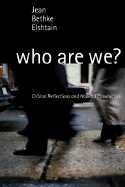
Book Review - Jean Bethke Elshtain's Who Are We?
In Who Are We?
Critical Reflections and Hopeful Possibilities, Jean Bethke Elshtain suggests
a way for Christians to interact with culture.
She identifies two mistakes people make when answering, “Who are we?” First, people use the word “prophetic” as a rhetorical
device. Elshtain instead proposes that
being prophetic means asking where current conditions and values may lead. Second, people do not ask enough questions. Liberals too often focus on possible good from
social reform without considering potential pitfalls. Conservatives look at the pitfalls without
considering potential good. Elshtain is
critical of both mistakes because they indicate an unwillingness to be faithful
to anything except self. She is hopeful
that it is still possible to be faithful to something more. Such faithfulness means that we see cultures as
ethical entities.May 9, 2012
Book Review - George Weigel's The Cube and the Cathedral
In The Cube and the
Cathedral: Europe, America, and Politics Without God, George Weigel describes
two worldviews. The first – represented
by the Great Arch, or, “the cube” – is a secular society. The second – represented by Cathedral
Notre-Dame, or, “the cathedral” – is Christian teaching. Which of these two worldviews can better
protect European democracy? According to
Weigel, the latter is at the root of Europe’s existence. Weigel argues that Europe faces a demographic
decline that comes from the values of a European culture that now embraces
secularism. He uses a religious
perspective to reflect on this change. May 2, 2012
Book Review - Tony Campolo's Red Letter Christians
In Red Letter
Christians: A Citizen’s Guide to Faith & Politics, Tony Campolo
introduces what it is to be a “Red Letter Christian.” Red
Letter Christians guides Christians who want to see their faith influence
their politics, while challenging the Christians as Republican stereotype. Campolo argues that Jesus does not fit into a
particular political ideology and that attempting to make him do so creates
division. Instead, Christians should
vote about social issues based on their best judgement of what God’s will
is. Addressing social need requires
political action, rather than only relying on the good work of volunteers. Simply put, it is sinful to pretend that
there is no need for legislative responses to oppression and poverty. April 25, 2012
Book Review - Miroslav Volf's A Public Faith
In A
Public Faith: How Followers of Christ Should Serve the Common Good,
Miroslav Volf argues that religious people should be able to bring their views
about what makes a “good life” to the public forum. This does not mean that Christians (Volf
writes from a Christian perspective and predominantly to a Christian audience) serve
the common good through theocracy, but instead serve it by being one of a
plurality of voices discussing what makes a healthy society. The Christian contribution to this discussion
should be rooted in the life and words of Jesus instead of ideology. Volf’s argument has two parts. In Part One, Volf acknowledges that
Christianity “malfunctions”. Highlighting
where Christians have erred in their approach to the good life allows Volf to suggest
a corrected vision. In Part Two, Volf discusses
how to present the corrected vision in a religiously and politically
pluralistic culture.March 7, 2012
Book Review - Stephen Lewis' Race Against Time
In Race Against Time, Stephen Lewis sets out to expand the
international discussion about UN renewal.
Lewis argues that this discussion – which typically includes the
Security Council, terrorism, and the Human Rights Council – must also include
development and humanitarianism, particularly in relation to Africa. During Lewis’ career in Africa, he was
unprepared for the “carnage” of HIV/AIDS.
He makes the unsettling statement that he has spent the last four years “watching
people die.” He and others “race against
time” to halt a seemingly endless epidemic that could kill a generation. Lewis sees hunger, AIDS, education, and gender
equality as four crucial areas and frames his argument with the UN Millennium Development Goals (MDG).
December 15, 2011
Book Review - Bill Clinton's Giving
In Giving:
How Each of Us Can Change the World, Bill Clinton explains why he chooses to give. Clinton gives because he
understands that not everyone has the same opportunities that he does. By giving, he hopes to help other people meet
their potential. Everyone has the
capacity to give. Doing so will change
the world because it allows people to recognize their common humanity. Clinton’s purpose in this book is to
encourage everyone to give, whether by sharing time, money, or skills or by
supporting ethical business, beginning a social enterprise, or forming an
NGO. To meet this purpose, Clinton tells
stories about people who give.August 17, 2011
Book Review - Joseph Heath + Andrew Potter's The Rebel Sell
In The Rebel Sell: Why the Culture Can’t Be Jammed, Joseph Heath and Andrew Potter challenge using countercultural or subversive behaviour to establish social justice. Their claim is that the ideals of the counterculture are the same things that drive capitalism and purchasing. Rebellious
purchasing, whether that be organic food, extreme sports, grunge
fashion, or something else, is sold on the same idea as a Lexus or Rolex
– the desire to be different. In essence, the counterculture cannot be co-opted because it does not exist.July 18, 2011
Book Review - N. T. Wright's Simply Christian
In Simply Christian, N. T. Wright explains Christianity. His goal is to recommend it to people who are not Christians, while also clarifying it to those who are. It is intentionally basic and seeks to give this explanation a “shape.” This shape has three parts. Part one claims that some elements of life point to something greater. Part
two describes what Christians believe and why Wright believes that the
something greater is the Christian God. Part three describes what
following God is like and what the church is for.
Subscribe to:
Posts (Atom)